If you love to travel, your passport matters a lot. Depending on which country it is from, it can limit where you travel, how long you can stay there, and how easily you can do different things while traveling (such as working while traveling). Did you know that you might be eligible for an EU passport that would make traveling around Europe much easier? My son is actually looking into this because my grandmother was German. Austria also offers this, and there may be some others as well.
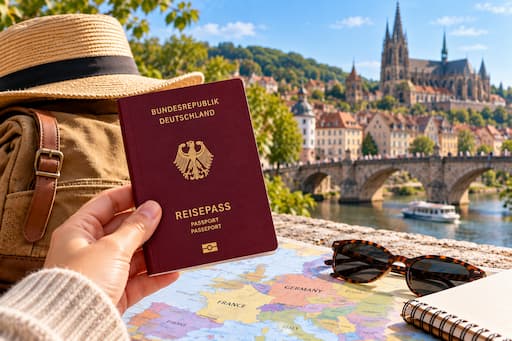
Instead of applying for a visa, your path to an EU passport might start with a family connection. You might discover that one of your parents or grandparents was born in a European country. This could let you obtain an EU passport by descent, which you may not have known you were entitled to.
If your parent, grandparent, or great-grandparent was born in Germany (a European country), you may already qualify for German citizenship by descent.
Before you can claim this right, you must meet eligibility criteria and provide documents showing your familial link to your parent, grandparent, or great-grandparent. Below is what you need to know about citizenship by descent and how it could change your travel in Europe.
What Does Citizenship by Descent Mean?
Citizenship by descent, known as ‘right of blood’, is derived from the Latin words ‘jus sanguinis.’ It is a principle that allows nationality to pass down through the family line rather than through the place an individual was born. For instance, if your ancestor was a German citizen, they may have passed that citizenship to you automatically at birth, even if you never knew or applied for it.
This is not the principle called ‘right of soil,’ which allows you to become a citizen of a European country based on where you were born. While most EU countries operate a mix of both principles, citizenship by descent (jus sanguinis) route (the right of blood) remains the most relevant pathway for individuals with European ancestry living outside the EU.
How Do I Know If I’m Eligible for an EU Passport?
To be eligible for an EU passport by descent, you must meet certain eligibility criteria, including:
Lineage Proof
You have to demonstrate that you have a direct ancestor who is/was a citizen of the relevant EU country. To demonstrate this, you must provide official birth or marriage certificates. Additionally, you can also provide other civil records to link each generation and prove your ancestral heritage.
Renunciation History
Note: your ancestors’ history can affect your eligibility for an EU passport by descent. This means that if your parent, grandparent, or great-grandparent voluntarily renounced their German citizenship (after obtaining another from a different country), they may have broken the link for you to become a citizen by descent.
General Limits
Rules for obtaining an EU passport by descent differ significantly between EU countries. Some countries limit citizenship by descent to parents or grandparents, while others allow longer limits, especially if the ancestral chain did not break.
Therefore, when seeking citizenship by descent in any EU country, always check its current nationality law rather than assuming a specific generation qualifies you.
How Does an EU Passport Change the Way You Travel?
Having an EU passport by descent can transform your movement in Europe in the following ways:
No Visa Lines
If you have an EU passport, you won’t need a visa to enter another EU country for short visits. You won’t be subject to the 90-day Schengen limit that applies to many non-EU nationals. As an EU passport holder, you can move within the EU territories using your valid passport or national identity card.
Seamless Movement
With an EU passport, you can move across Europe easily thanks to the free movement rights EU citizens enjoy. As a result, you may be able to use EU, EEA, or Swiss citizen lanes (where available) at airports. However, border checks may still occur at different ports of entry. As such, you should carry valid travel identification in case border officers need more information about you.
Extended Stays
As an EU passport holder, you can stay in another EU country for longer than a usual non-EU national. If you move to these EU countries for study, work, retirement, or another allowable reason, you can exercise EU free movement rights under the relevant conditions.
What Documents Do I Need for Citizenship by Descent?
Your circumstances will determine the exact combination of documents you must provide to probe your eligibility for an EU passport by descent. This means different applicants must gather documents showing their ancestral link to a European country. If you’re applying for citizenship by descent, you might need the following documents:
- Your birth certificate
- Your parent(s) birth certificates
- Your parents’ marriage certificate (if required)
- Your valid national passport
- Any other forms of your ID
- Your certificate of good conduct from the country where you live
- Paternity test results of your biological father (where applicable)
Living and Working Anywhere in the EU With a Passport
You can live and work in other EU member states using an EU passport. You wouldn’t need to apply for a traditional work visa. As a result, relocating for study, employment, retirement, or family can be much easier. Additionally, you have the same access to local job opportunities as residents of the country where you are employed.
You can stay up to three months without a visa. But if you want to stay and work for more than three months, you must meet specific conditions and complete other administrative requirements, such as registering. And if you live in most EU countries for up to five years uninterruptedly, you may qualify for permanent residency.
Key Takeaways
Citizenship by descent is a reliable route to EU citizenship for individuals with eligible ancestry to a European country. With your European passport by descent, you can enter other EU member states for short stays without a traditional visa.
As an EU passport holder, you can move freely and live, study, or work in other EU countries. This is a significant privilege that non-EU nationals do not have. Applicants must provide sufficient documents proving their unbroken ancestral heritage to an EU country before applying for citizenship by descent.