
I apologize in advance that this post is more different than my other foraging identification posts. You might notice photo attributions under some of the pictures, because I didn’t take lots of pictures with the plan of making this post, but then I decided I couldnt miss out on posting about this plant, since I don’t usually have the opportunity.
So, an impromptu post about foraging watercress.
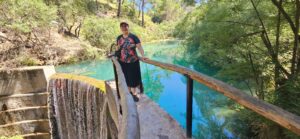
I mentioned that I went on a camping trip, and the second day there I scouted out a place for a foraging class the following week, and I found an area with a waterfall leading into a lake, with a bunch of wild edible plants growing there. Then I taught the class, and one of the plants we foraged and cooked with was watercress, and it was a hit with all the members of the class.
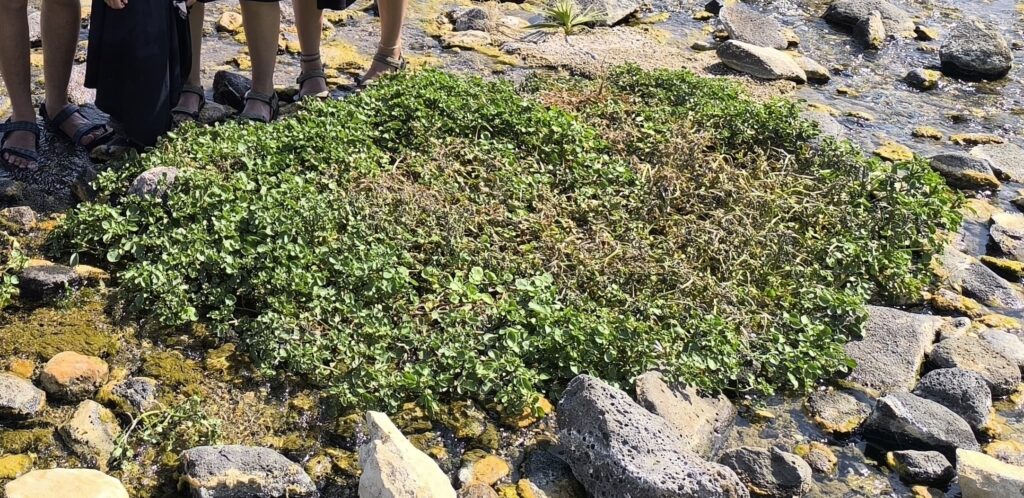
But, of course, I didn’t take a picture of the watercress. I have a picture of the family standing behind the watercress, so I cropped it so you could see how the watercress was growing, but it isn’t a clear picture, which is why I found stock photos online of this plant, so I can teach you how to forage it.
So, what is watercress?
Watercress is a member of the brassica or cruciferous family, also known as the mustard family, the same family that contains mustard (duh), cabbage, broccoli, cauliflower, turnips, radishes, collard greens, kale, kohlrabi, horseradish, arugula, and more.
Every member of this family is entirely edible, so if you can identify something as being a member of this family, you can safely eat it, even without knowing for sure which species it is.
This is why I feel totally comfortable teaching you how to forage watercress, even with only one unclear picture taken by me, and the rest stock photos. Because you really can’t go wrong here, if you follow the identification information I give you.
There’s two ways that watercress can confuse you, but those can be easily overcome by following the identification information.
First off, you have its scientific name, nasturtium officinale. Sound familiar? You might have noticed it sounds like official nasturtium. But it isn’t related at all to the plant known as nasturtium. Nasturtium is scientifically called tropaeolum. This is why scientific names are important. They both have that name because in Latin, it means twisted nose, since they both have a peppery taste to them.
Then there’s a plant that grows in the water as well, often in similar places, known as fool’s watercress, because people confuse them as they are both edible. But they don’t look alike at all in my opinion, especially with different types of flowers, and I’ll be posting about them soon, since we foraged and cooked with both of them as part of our foraging class.
Watercress is native to Eurasia but has been introduced by settlers and is a wild invasive species now across the world. There are also native members of the same family that grow in Hawaii, New Zealand, etc… It is also cultivated all over the world.
It is one of the oldest known leaf vegetables consumed by humans.
So, how do you identify it?
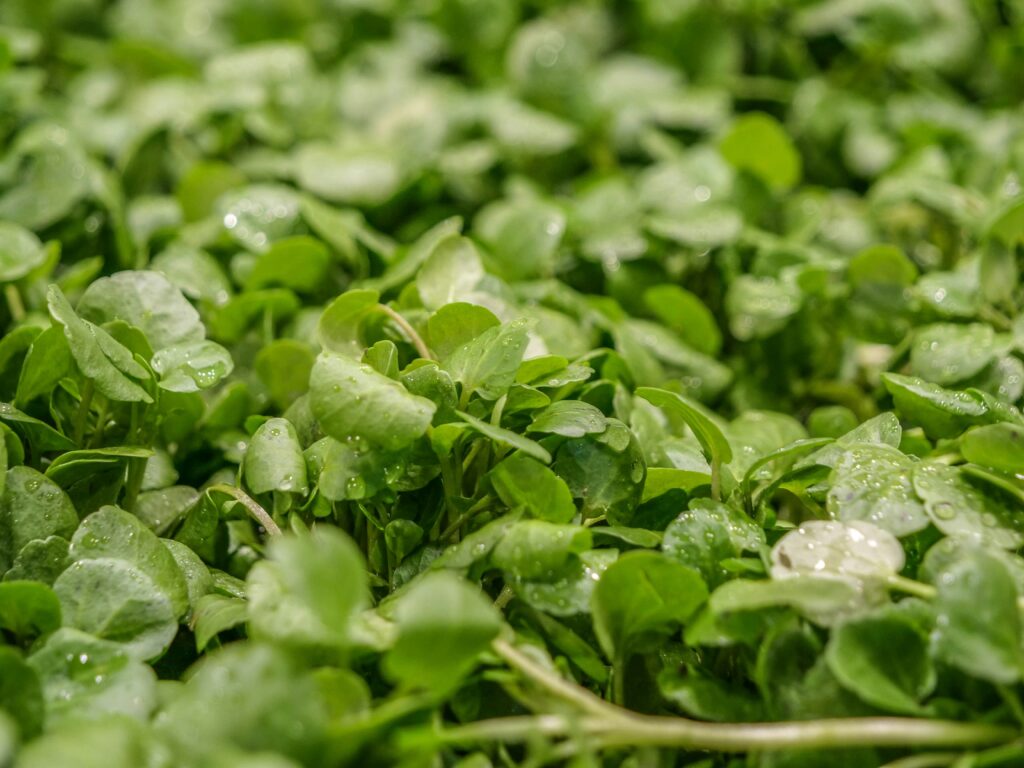
First off, it grows in water. So if you don’t have water, it isn’t watercress. It needs to grow in shallow enough areas for the roots to reach the ground, so it isn’t deep water. As you can see in the second picture, it can be just a small amount of water, but the water needs to be there.
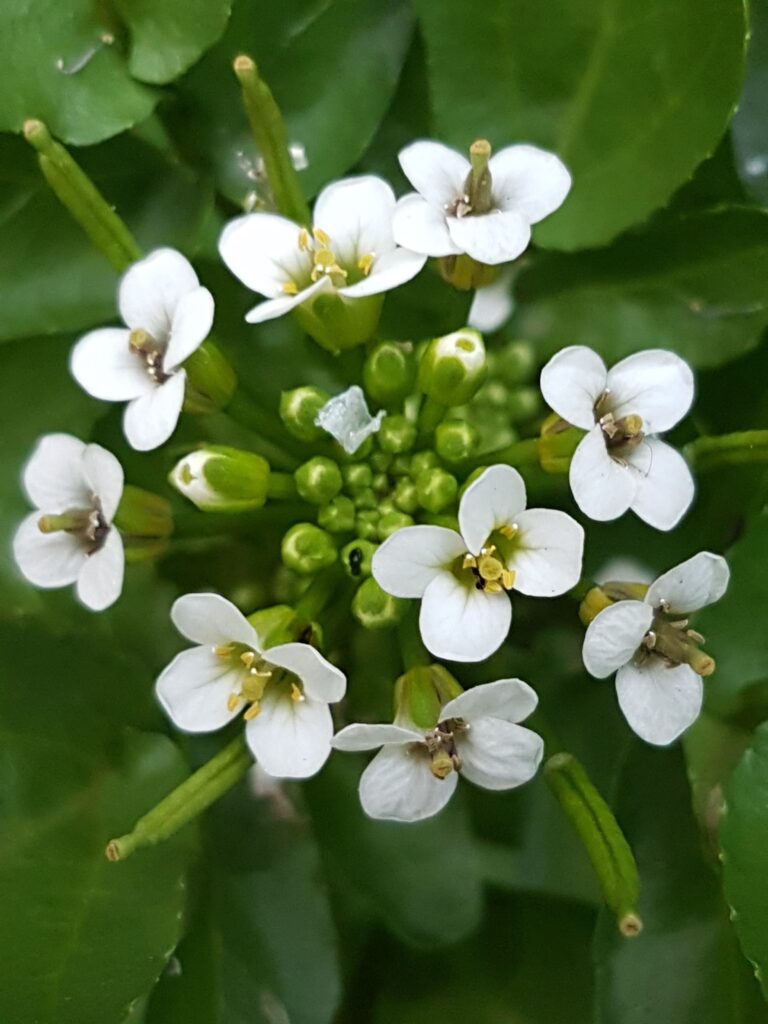
Second of all, it is in the mustard family, the cruciferous family, and everything in the cruciferous family has little 4 petaled flowers (in the shape of a cross, hence crucif…) growing in a bunch at the top of a stem, from buds that look like tiny heads of broccoli (also in the mustard family, and whose buds all open to become 4 petaled yellow flowers if left to grow too long).
If you see four petaled flowers growing in a bunch like this at the top of a stem, and they are white, and it is growing in water, congratulations, you’ve found watercress. The stems are follow and float in water, and the leaves start off oval but then become elongated with a rounded part at the end and then rounded lobes on either side of the leaf.
Often when people buy watercress it is very immature plants, so they’re just tiny round leaves on a stem, but your foraged watercress is going to be much bigger, most likely.
I’m going to point out a plant that looks nothing like this, but people should be aware of it when foraging water plants. Water hemlock is a very poisonous plant that also grows in the water. Its leaves look nothing like this and its flowers look nothing like this, so you don’t have to worry. Just don’t assume all plants growing in bunches in the water are watercress and you’ll be fine.
Great- so now that you identified watercress, does that mean you can just eat it?
Not exactly.
As an aquatic plant, parasites are a potential issue.
Plants growing in slow moving or stagnant water have the largest parasite issue, because there isn’t a steam of water washing away the parasites. These watercress that I found were at the edge of a lake, near a waterfall that deposits into the lake, but far enough away that there was no rushing water there, which meant a risk of parasites was higher. When the water is rushing, it isn’t a concern, unless it is downstream from a place contaminated by manure, so you should know the source of the stream if you want to forage it.
To prevent the risk from parasites if you are picking from a place with a potential parasite issue, there are two main options:
Pick from above the waterline. Parasites live in water and don’t crawl up stems, so submerged parts are where the risk is found. Picking parts that are above the water entirely, especially above a potential splash zone, means that your watercress is safe to eat. (This goes for other wild edibles growing in water as well.) So for my foraging class, we picked leaves that were growing well above the water line.
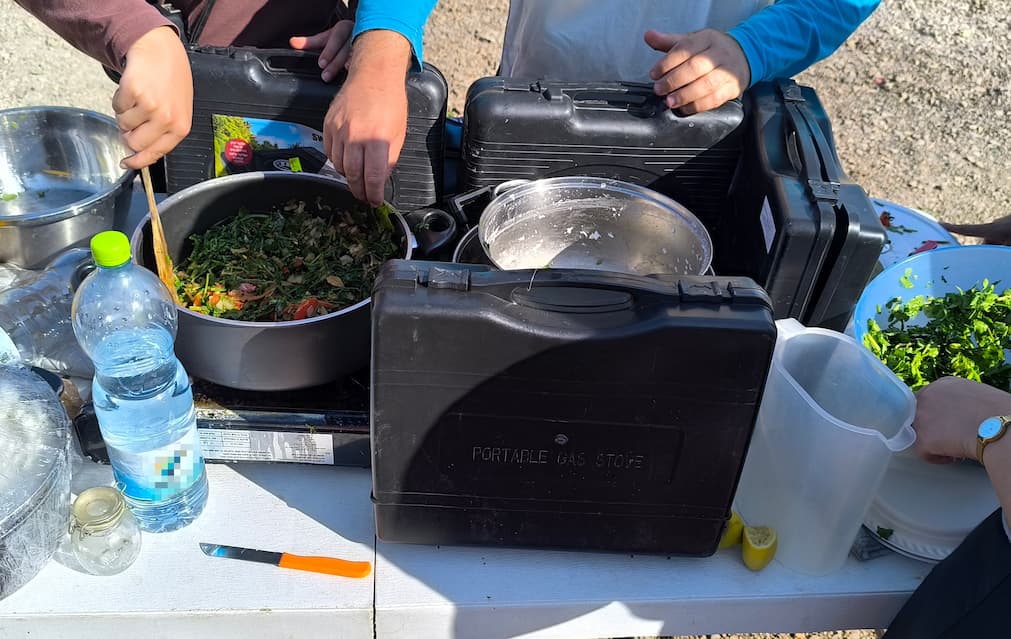
The second option is to cook it. Some foragers cook every water plant; I think that is overboard, but it is your call. However, since cooking kills any potential parasites, making your foraged plant entirely safe to eat, if you’re eating plants from potentially contaminated areas, cooking is a good idea. This is why, for my foraging class, other than a few leaves to taste that were picked above the waterline, the watercress got cooked into an Indian curry, as shown above.
Watercress is spicy like arugula, but when you cook it it becomes more bitter, like most members of the mustard family, but not too bitter. If you don’t like bitterness, boil it in water for a few minutes, then squeeze it out, and most of the bitterness will have been removed.
Simple as that.
Now go out and forage!
Have you ever had watercress before? What is your favorite way to prepare it? Did you forage it or buy it in a store?
Have you ever seen watercress growing wild before? Do you think you’d now feel safe enough to forage it?