
My kids recently switched bedrooms so we had to redo them to suit the kids who now live in them (an adult and a computer programming 12th grader is different than a preteen and a teenager). But let’s say your kids didn’t switch bedrooms and just grew up- there’s a way to design a bedroom so that it grows with your kids so that you don’t need to spend a lot of money to redo the bedroom every few years. Here’s how.
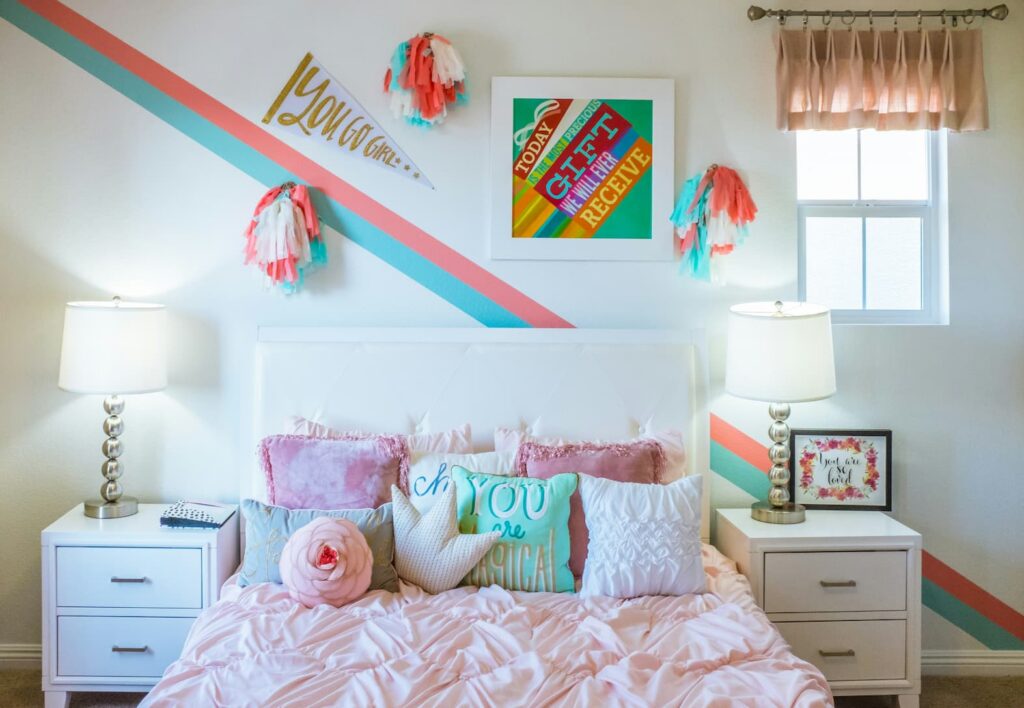
Children’s rooms get redone more often than any other room in the house, and mostly for the same reason: the room was designed for the child they were, not the one they’d become. The nursery with the animal mural is wrong by four. The dinosaur room is embarrassing by eight. The bunk beds are outgrown by eleven. Each redo costs money and a weekend, and the pattern repeats until the child leaves.
A room that grows with a child is designed differently from the start: neutral bones, changeable surfaces, and furniture bought for the ten-year-old, not the two-year-old.
Neutral Bones, Changeable Layers
The principle is simple. Anything expensive or hard to change, the paint on the walls, the flooring, the main furniture, is neutral. Anything cheap and easy to change, bedding, wall art, cushions, a rug, carries the child’s current obsession. When the obsession changes, and it will, the change costs a duvet cover and an afternoon.
A pale or mid-tone wall in a colour the child could live with at fifteen, warm white, soft grey, a muted green or blue, is the base. One feature wall in a stronger colour is fine if it’s a colour, not a theme. Wall stickers, prints in frames and a pinboard carry the theme instead, and all of them come off.
The Bed That Lasts
The single most expensive item, and the one most often bought wrong. A toddler bed lasts two years. A cot bed lasts until four or five. A full-size single lasts until the child leaves home, and it’s the sensible purchase from the moment the cot’s outgrown, with a guard rail for the first year or so. The room may need rearranging to fit it, but a bed bought once at three beats a bed bought three times.
The mattress can outlast the child’s obsessions too if it’s chosen properly. The good mattresses for single beds are built to support a growing body through the years when it changes most, and a child who sleeps well in a comfortable bed is a child who’s easier to live with by every measure. A waterproof protector underneath for the early years, changed out for a plain one later.
For small rooms, a mid-sleeper or high-sleeper at around six or seven, with a desk or storage underneath, is the version that grows with the room as well as the child. The frame should be one the child can use safely alone, which usually means waiting until they’re old enough to manage the ladder.
Storage That Changes Its Job
Storage is where children’s rooms fail and where a little planning pays off for a decade. Open cube shelving is the workhorse: at three it holds baskets of toys, at seven it holds books and boxes, at twelve it holds whatever a twelve-year-old holds, and the same unit does all three. A chest of drawers in a size that suits an adult holds baby clothes in a third of the space and teenage clothes in all of it. A wardrobe with adjustable rails and shelves starts low and rises.
The things to avoid are storage sized for a child, which is outgrown, and themed storage, which is embarrassing. Baskets in a neutral fabric do the toy phase without committing the room to it.
Lighting And Power
A ceiling light on a dimmer, a bedside lamp the child can reach and operate, and, from about six, a desk lamp. Sockets in the right places matter more as the child grows: by the bed for a lamp and, later, a phone; by the desk for everything else. Adding sockets is easier during a redecoration than after, and worth doing once.
A Desk From The Start
Even a toddler’s room benefits from a small table and chair, for drawing and jigsaws, and it teaches the idea that the room has a place for doing things. By seven, homework needs a proper desk; by twelve, the desk is where the child lives. Buying an adult-sized desk at seven, with a chair that adjusts, means it’s never replaced. A desk with drawers doubles as the storage the room will need for stationery, chargers and the rest.
The Changeable Layer
This is where the child gets to choose, and where the choices are allowed to be terrible. Bedding in the current obsession. Posters and prints, framed so they look intentional, pinned so they come down. A rug. A beanbag or floor cushion. A noticeboard or a wire grid for photos and cards. Fairy lights. A colour on the feature wall that’s repainted every few years. All of it cheap, all of it theirs.
Letting the child drive this layer is what stops them wanting to redo the whole room. They’ve already got the part they care about.
Room For Friends
From about eight, the room becomes social. Space for a sleepover, whether a trundle under the bed, a second mattress in a cupboard or a sofa bed that’s actually comfortable. Somewhere to sit that isn’t the bed. A door that closes. Teenagers need the room to be a retreat, and a room designed for that from the start doesn’t need reinventing at thirteen.
The Bottom Line
A child’s room grows with them when the walls, floor and furniture are neutral and sized for the adult the child will become, and when everything the child actually cares about, the colour, the theme, the posters, sits in a layer that costs almost nothing to change. Buy the single bed and the mattress once, the desk once, the shelving once. Let the duvet cover do the work.