
This post was written by team member, Tracey Marks.
The truth is, I don’t. It’s still hard. A lot of things don’t get done if I don’t ask. Twenty times. And then, of course, it’s just easier to do it myself. Isn’t it?
So, I know nagging doesn’t work. All it does is get me irritable and get them annoyed. And maybe they’ll kind of half do it, and then I still have to fix it after them. But doing everything myself will fast-track me to burnout. So, I know I need a new strategy, just like when I’m trying to make any change.
So, first, it’s important to name the change. From a kid’s perspective, they see it as Mom’s job to take care of the house. The change I want is for them to deeply buy into and be excited about “We’re a team, and we take care of our space together.” (Ok, they don’t need to be excited, it is cleaning after all. But yes, feel that it’s their issue too and feel proud when they succeed.)
So here are some of the ideas I’m trying out that are beginning to make the change I want to see.
I’ve Rebranded Chores
The word “chore” has a built-in negative PR problem. It sounds heavy, boring, and punitive. If you tell a kid, “It’s time to do your chores,” their brain immediately registers it as a punishment. Seriously, would you want to do chores??
Instead, I’m rebranding the entire concept to “Family Time” or “Teamwork Time.” I sat my kids down during a calm moment (not in the middle of a messy room crisis) and explained a basic family rule: everyone who lives in the house consumes resources, eats food, and makes messes, which means everyone is responsible for maintaining the ecosystem. Framing it as a natural part of being a team makes it about community and belonging, rather than an arbitrary command from management. And we try and have fun during our “team time”. Music, jokes, everything helps.
Beat the Clock and Other Games
Kids love a challenge. Mine do at least. So, when I’m not burnt out and I remember, I turn our tasks into games. Then I’m not the boss, the clock is. Here are some ideas we use.
- The 5-Minute Blitz: Set a loud physical timer on the kitchen counter for five minutes. Put on a high-energy, fast-paced song. The challenge is: Can the family beat the clock and get all the toys into the bins before the alarm goes off?
- The “Beat Your Record” Challenge: Time how long it takes them to clear the dinner table on a regular night. Write it down on a whiteboard. The next night, challenge them to beat their previous record by five seconds.
By shifting the focus to a countdown, we eliminate the power struggle. I don’t have to lay down the law, they want to win.
Be Very Specific
If I tell my son to clean his room, he will hide his piles of laundry under his comforter. But, if I give him detailed tasks, he tends to do them. Children sometimes experience task paralysis: when you say “clean your room,” their brain views that as a massive, overwhelming mountain. They don’t know where to start, so they don’t start at all.
So, my solution has been to break the visual chaos down into hyper-specific, micro-steps.
- “First, I want you to pick up every piece of clothing on the floor and throw it into the laundry basket.”
- “Next, put all the books back on the shelf.”
- “Finally, grab all the trash and put it in the bin.”
If your kids are visual, create a simple checklist with icons or checkboxes and laminate it. Let them use a dry-erase marker to physically check off the boxes. The neurological hit of satisfaction they get from crossing an item off a list is an incredible motivator.
Embrace the “Perfectly Imperfect”
You can have a spotless home with clothing lined up like soldiers, or you can have help in the house. You generally can’t have both. So, if you want your kids to help, accept that a seven-year-old is not going to fold a fitted sheet like a professional housekeeper, and a ten-year-old might leave a few crumbs when they wipe down the counter.
I think one of the hardest things for a child is when they really make an effort but their parent says “Nice try, but let me fix it.” I have to hold my tongue sometimes but really, this is so unhelpful and maybe even mean. The moment I re-do a task my child just finished, I’m sending a loud, clear message: Your effort isn’t good enough, and I will eventually do it for you anyway. Accept the slightly crooked blanket on the bed. Praise the effort and the completion of the task. As their fine motor skills and attention to detail grow over time, the quality of the work will follow.
This applies even to teenagers. Yes, they could do better if they try but if at the moment they are making a minimal effort and I tell them it’s not good enough, then why should they try again? This is when I go back to the previous rule of being more specific next time.
Tie Privileges to Contributions
I don’t like being transactional with my children, so I don’t say clean the table and then you’ll earn screentime. I frame it differently: First, take care of responsibilities, and then you can relax. Not the other way around. This way, I don’t need to argue or threaten to take away screentime. I simply enforce a “When / Then” boundary.
- “When your backpack is unpacked and your shoes are in the closet, then you can turn on the TV.”
- “When the dishwasher is emptied, then you can go to your friend’s house.”
I really work on myself to deliver this phrase calmly, neutrally, and exactly once. Although sometimes I am sorely tempted, I try as hard as possible not to yell across the house. If they ask for the iPad before the task is done, I just repeat the phrase like a broken machine with a pleasant smile. The beauty of this rule is that the responsibility shifts entirely onto them. You aren’t withholding the screen; their own choice to delay their contribution is withholding the screen.
Match the Task to the Age: A Quick Cheat Sheet
I asked my new friend Gemini to help me design a list of what chores different aged kids can do. Some, I started earlier with my own kids and some I’m like, cool, let me try that! But here it is, a way to gauge when kids are ready for what home responsibilities. Often, we don’t ask kids to help because we genuinely forget what they’re capable of doing. Kids are incredibly resourceful when given the chance. Use this quick guide to assign age-appropriate expectations:
| Age Group | Capable Tasks |
|---|---|
| Toddlers (Ages 2–3) | Putting toys in a bin, placing dirty clothes in a hamper, wiping baseboards with a damp cloth, matching socks. |
| Preschoolers (Ages 4–5) | Making their bed (roughly), feeding pets, clearing their own plate from the table, watering plants. |
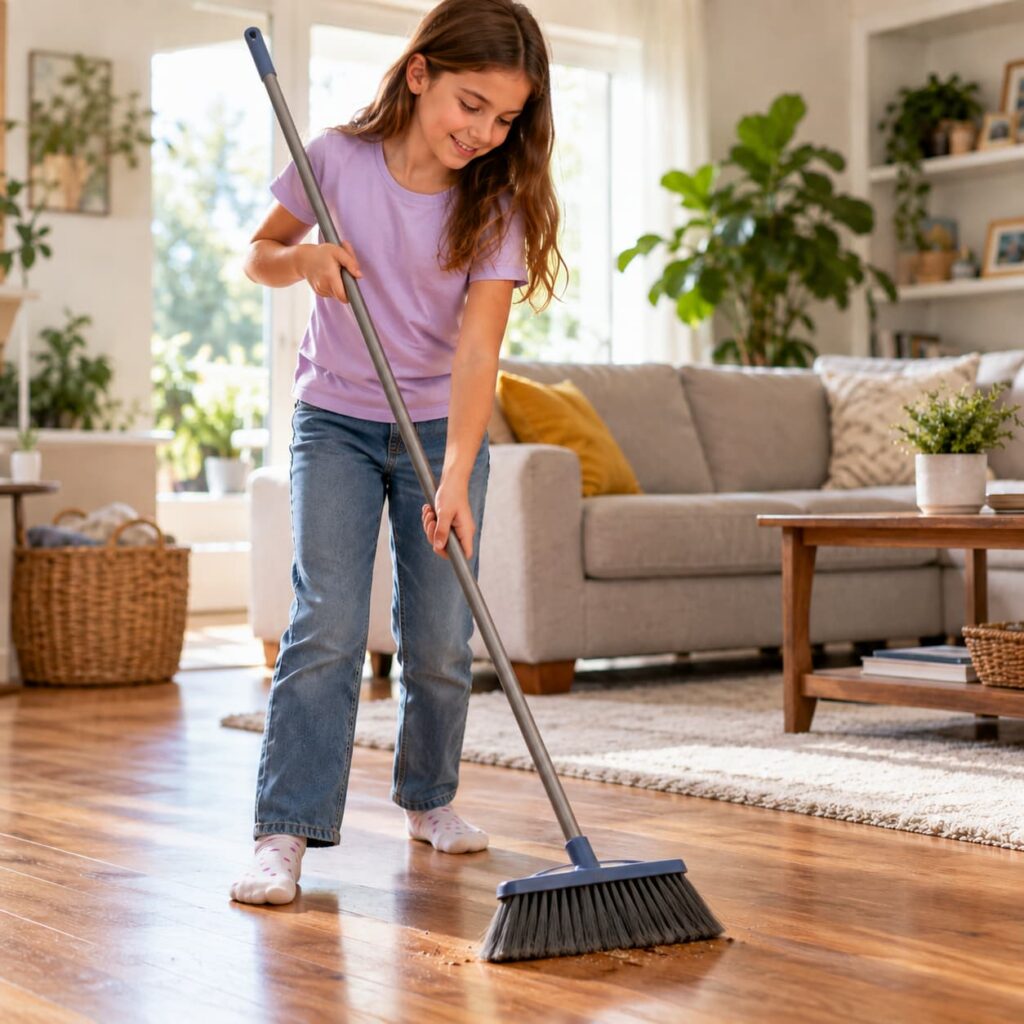
| Early Elementary (Ages 6–8) | Emptying the dishwasher silverware, sweeping floors, taking out light trash bins, packing their own school lunch. |
| Tweens & Teens (Ages 9+) | Loading the dishwasher, doing their own laundry from start to finish, walking the dog, cleaning the bathroom, cooking basic meals. |
The Ultimate Payoff: You’re Raising Future Capable Adults
It is easy to forget in the middle of a mess of a week that teaching your kids to clean isn’t actually about getting the task itself done. It’s about character development.
When you hold the line and expect your kids to contribute to the household, you’re teaching them executive functioning, time management, accountability, and life skills. You’re ensuring that when they eventually move out into the real world, they won’t be the college roommate everyone hates or the partner who doesn’t know how to run a washing machine. And that, I think, is the biggest win of all.