
If you’re handy, you can save a lot of money by doing things yourself and building things from scratch. Making home storage out of plywood is a relatively easy project for beginners that can save you a lot of money. Here are some ideas for how you can do that, sent in by a reader.
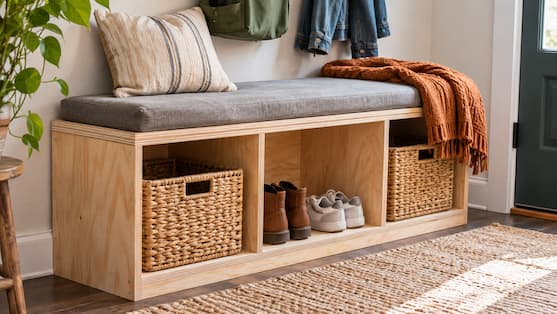
My neighbor paid $680 for a mudroom bench with cubbies last spring. It arrived flat-packed, slightly warped, and held together with cam locks that stripped the first time she tightened them. I built a sturdier version for my own entryway for about $95 in materials and one Saturday afternoon. That gap in price isn’t unusual. It’s the norm.
Storage furniture carries some of the ugliest markups in retail. You’re paying for shipping bulky air, for showroom space, and for a brand name stamped on particleboard. Strip all that away and what’s left is wood, screws, and a few hours of your time.
Why Store-Bought Storage Costs So Much
Walk into any big-box retailer and look at a six-cubby shelving unit. Retail price hovers around $130 to $200. Flip it over and you’ll find melamine-coated fiberboard roughly half an inch thick, held together by plastic dowels. The raw material cost is maybe $25.
Real wood construction costs more upfront but lasts decades instead of years. I still have a toy chest my father built in 1987. The particleboard dresser I bought in college lasted three moves before the back panel fell out entirely.
The Material That Changes Everything
Plywood is the frugal builder’s secret weapon. It’s dimensionally stable, it doesn’t warp like solid pine, and it takes screws without splitting. For most household storage projects, 12mm plywood sheets hit the sweet spot. Thick enough to carry weight, thin enough to keep the whole build light and cuttable with a basic circular saw.
A single sheet yields a surprising amount. One 8×4 panel can produce an entire set of garage shelves, a under-bed rolling drawer, and a small toy bin with offcuts left over for shelf cleats.
Five Projects That Pay for Themselves Immediately
Start small. Confidence builds faster than skill, and the first finished project makes the second one feel easy.
- Under-bed rolling drawers. Four sides, a base, and $8 worth of casters. Store-bought equivalents run $45 each in fabric that sags. Mine have survived four years of two kids using them as step stools.
- Floating shelves. A plywood box skinned over a hidden cleat looks identical to the $90 ones at the home store. Material cost: about $12 each.
- Garage wall shelving. Vertical uprights with horizontal shelves, screwed into studs. Twelve linear feet for roughly $70. Pre-made steel racking starts at $180 and wobbles.
- Entryway bench with cubbies. The project that started all this for me. Three cubbies, a hinged lid, and a cushion from a thrifted pillow.
- Closet organizer inserts. Those wire systems cost $150 and sag under sweaters. Plywood shelving doesn’t.
What You Actually Need to Own
You don’t need a workshop. A circular saw with a clamped straightedge produces cuts just as straight as a table saw. Add a drill, a tape measure, a carpenter’s square, and some wood glue. That’s roughly $150 in tools if you buy new, or $60 at a decent estate sale.
Many lumber yards will rip sheets down to your dimensions for a dollar or two per cut. Hand them a cut list and let their panel saw do the heavy work. Then you’re just assembling at home, which is far less intimidating.
Where Beginners Lose Money
Measure the space three times. Not twice. I once built a pantry shelf unit that was three-quarters of an inch too wide for the alcove and spent an evening with a hand plane fixing my own arrogance.
Buy quality screws. The bargain bucket of drywall screws snaps under torque and leaves broken shanks buried in your workpiece. Spend the extra $4 on proper wood screws with a torx head.
Don’t skip the glue. Screws alone create joints that loosen over time. Glue plus screws creates a bond stronger than the wood itself. A $6 bottle covers a dozen projects.
Finishing on a Budget
Sand to 120 grit and stop. Going finer wastes time and money on projects that live in a garage or closet. For visible pieces, a $15 quart of water-based polyurethane covers two coats on a full bench. Edge banding costs about $12 a roll and hides plywood layers convincingly, though plenty of people leave the stripes exposed now as a design choice.
Running the Real Numbers
Over three years, I’ve built eleven storage pieces for our home. Total material spend: around $740. The closest retail equivalents would have cost somewhere north of $3,200, and I know from experience that at least half of them would already need replacing.
That’s not a hobby. That’s a $2,400 raise for about forty weekend hours of work, which beats most side hustles I’ve tried.
Pick one small project this month. A single shelf. See how it feels to walk past something you made with your own hands, holding exactly what you need it to hold, in exactly the space you had.