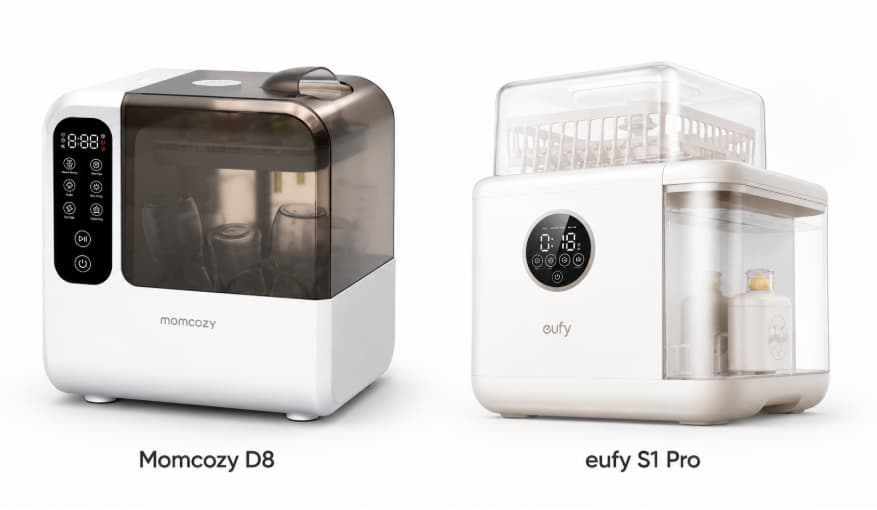
If you’re a pumping mom, you might be debating between two great options, the Momcozy D8 and the Eufy S1 Pro. How do the two compare, and which one makes more sense for your needs? Here’s a comparison of the two, including the pluses and minuses of each, so you can see for yourself.
By the end of a day of feeding and pumping, the kitchen counter can hold far more than a few empty bottles. Flanges, valves, nipples, tubes, straws, pacifiers, and milk-storage accessories can quickly pile up, each with small openings, curves, and hard-to-reach areas that make cleaning more complicated.
That makes the Momcozy D8 vs. Eufy S1 Pro comparison about more than which machine washes bottles. Both automate a time-consuming task, but the more practical question is which one is better equipped for the full range of feeding and pumping gear that needs cleaning.
Momcozy D8 vs. Eufy S1 Pro: Key Specifications
The Momcozy D8 and Eufy S1 Pro both automate washing, steam sterilization, drying, and storage for baby feeding gear, with support for bottles, pump parts, and small accessories.
The D8 is purpose-built around the cleaning demands of bottle- and pump-heavy feeding routines. It can clean up to eight bottles or one full pump-parts set per load and combines 64 multidirectional jets with up to 112,000 Pa of spray pressure. Patented TargetWash focuses on narrow accessories such as nipples, tubes, and straws, while Pump360 uses patented accessories to convert direct water flow into multiple rotating streams, helping water reach the interior surfaces of irregular pump parts from changing angles. It also adds a dedicated Self-Cleaning Mode and GlideWheel mobility for everyday countertop use.
The Eufy S1 Pro takes a different approach, combining 3D HydroBlast cleaning with an advertised 8+2 bottle configuration, app-based controls, and a built-in water-softening system. The two additional bottle positions come with height limitations in the supplied testing, which are discussed in more detail below. By comparison, the D8’s adjustable spray-rack height is designed to accommodate a wider range of bottle heights. Eufy places more emphasis on capacity and connected features, while the D8 focuses more heavily on specialized cleaning paths for the mix of bottles, pump parts, and small accessories that pumping families handle every day.
Cleaning Bottles is Only Part of the Story
For pumping parents, the most frustrating pieces are often not the bottle bodies themselves. Nipples, valves, straws, tubes, and pump components have narrow passages, folds, seams, and irregular surfaces that can hold onto milk residue and take considerably more time to clean by hand. Because these parts routinely come into contact with breast milk or a baby’s mouth, thorough cleaning matters beyond convenience.
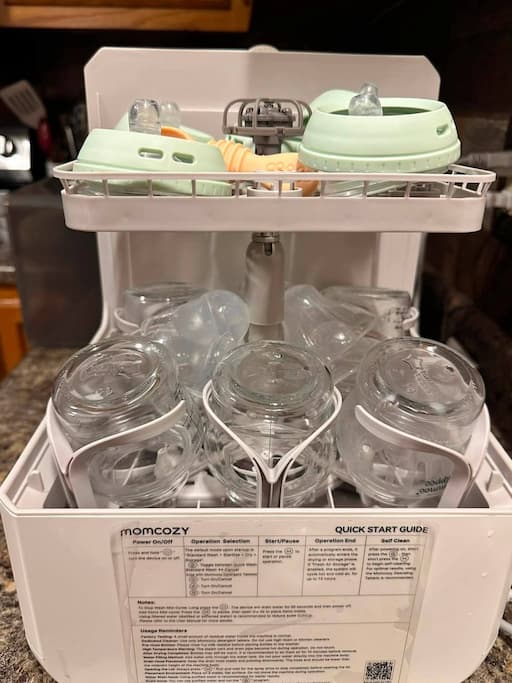
TargetWash is designed specifically for small feeding accessories such as nipples, tubes, straws, and pacifiers. Rather than simply placing these pieces on an upper rack, the system directs water toward narrow openings and hard-to-reach surfaces, supporting precision cleaning for up to eight small accessories.
Pump parts present a different cleaning challenge because their curved interiors and irregular surfaces can be difficult for a general spray system to reach consistently. Pump360 uses patented accessories to convert direct water flow into multiple rotating streams, helping water reach curved and hard-to-reach interior surfaces from changing angles.
The Eufy S1 Pro can also clean bottles and breast pump parts using its 3D HydroBlast multi-directional spray system. The distinction is that the D8 adds dedicated cleaning systems for specific feeding components: TargetWash directs water toward small accessories with narrow openings, while Pump360 uses rotating streams to reach curved and irregular pump-part surfaces from changing angles.
Cleaning Performance
Both machines use multi-level spray systems, but the supplied comparison data gives the D8 a clear pressure advantage: 64 jets and up to 112,000 Pa versus 59 nozzles and approximately 22,000 Pa for the S1 Pro, or roughly five times the pressure.
That higher pressure, paired with multidirectional coverage, is designed to help loosen dried milk residue and improve water coverage across both the inside and outside of feeding components. Eufy’s 3D HydroBlast system also uses multiple spray directions, but the D8 adds dedicated TargetWash and Pump360 pathways for small accessories and irregular pump parts.
Sterilization and Hygienic Storage
For feeding items, the D8 uses high-temperature steam sterilization as part of its cleaning workflow. After washing and drying, cleaned bottles, pump parts, and accessories can remain in hygienic storage for up to 72 hours, helping keep frequently used feeding gear ready between sessions.
Self-Cleaning and Machine Maintenance
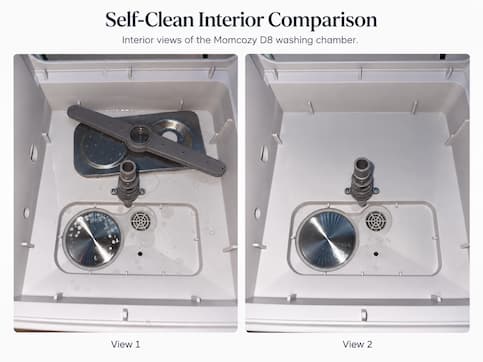
Separately, the D8 includes a dedicated Self-Cleaning Mode for the chamber and internal water path. The cycle is designed to help remove limescale and residue from the washer itself while running a high-temperature sanitizing process, reducing the amount of machine maintenance parents need to manage separately.
The Eufy S1 Pro takes a different approach with a built-in water-softening system intended to reduce hard-water spotting and mineral buildup. The softener is a replaceable consumable; at the time of writing, Eufy lists a replacement at $49.99 and recommends changing it every 40 to 60 days.
The two systems address different maintenance needs: the D8 includes a dedicated cycle for cleaning the washer itself, while Eufy conditions the water used during washing and requires periodic softener replacement.
Capacity and Everyday Workflow
Eufy advertises capacity for up to 10 bottles, while the D8 accommodates up to eight bottles or one full set of pump parts. The 10-bottle headline needs some context, though, because the two additional bottle positions in the supplied test setup are on the nipple rack rather than the main bottle area.
In the supplied testing, those extra positions worked best with shorter bottles. Standard-height bottles could interfere with the upper spray arm, limiting its movement and reducing spray access to items on the upper level.
For pumping households, the D8’s pump-parts configuration may be more useful than comparing bottle counts alone, since it can devote a full load specifically to pump components.
Water Use, Drying, and Everyday Controls
The supplied comparison testing gives the D8 a water-use advantage at approximately 2.85 liters per comparable cycle versus 4.45 liters for the S1 Pro. These figures should be understood as results from the supplied comparison testing rather than universal consumption figures across every mode or load.
Eufy, however, offers more app-based control. The S1 Pro supports connected controls and customizable drying options through its app, including shorter drying programs under specific settings. For parents who value remote control and greater cycle customization, that is a genuine Eufy advantage. The D8 does not offer the same level of app-based customization, instead putting more emphasis on dedicated cleaning systems, Self-Cleaning, and straightforward onboard controls.
Countertop Space and Mobility
The D8’s lower, more rectangular footprint makes it easier to position beside a sink or under upper cabinets, where vertical clearance can be limited. Based on the supplied dimensions, it takes up substantially less overall volume than the S1 Pro, and its horizontal lid opening requires less overhead space than Eufy’s vertical-opening design. The GlideWheel design also lets the D8 slide and rotate on the countertop rather than being lifted whenever it needs repositioning.
That mobility matters once a washer is filled with water and becomes awkward to carry. For parents who keep the machine in a fixed kitchen work zone, being able to roll or rotate the D8 can make loading, refilling, and cleaning around the unit easier in everyday use.
Verdict: Which Is Better for Which Parent?
For pumping families who regularly clean bottles, flanges, valves, nipples, tubes, straws, and other small feeding parts, the Momcozy D8 is particularly well suited to more complex pumping routines. TargetWash targets narrow accessories, while Pump360 changes the spray angle around irregular pump components. Combined with roughly five times the spray pressure in the supplied comparison data, Self-Cleaning, lower water use, a smaller overall machine volume, and GlideWheel mobility, the D8 addresses several of the practical pain points that come with a full pumping routine.
The Eufy S1 Pro still suits parents who prioritize app-based control, built-in water softening, or its advertised 10-bottle capacity. But that capacity comes with loading caveats in the supplied testing, and the softener adds a recurring replacement cost. For households whose daily load is a mix of bottles, pump parts, and tiny feeding accessories, the D8 places more of its design emphasis on the cleaning task itself.