
This post is written by team member Hayman Zanetti.
I have a master’s degree and work professionally with children with special needs and learning challenges. Through my work, I’ve seen how the right tools and support can make everyday life easier for both children and their parents. Here are some practical strategies that can help children with ADHD develop stronger organization skills.
Many parents of children with ADHD know the scene all too well: every morning begins with a race against the clock. The backpack still isn’t packed, a notebook has disappeared, the other shoe is nowhere to be found, and the child seems completely unaware of why everyone else is stressed. In situations like these, it’s easy to assume that the problem is irresponsibility or laziness, but research paints a very different picture.
For children with ADHD, difficulties with organization and keeping things in order don’t stem from a lack of motivation. Rather, they are related to challenges with the brain’s executive functions. Once we understand where the difficulty comes from, the way we help the child changes as well. Instead of trying to “teach them to be organized,” the goal is to teach specific skills and create systems that allow the child to succeed.
Why Do Children With ADHD Struggle to Get Organized?
Executive functions are a set of abilities that allow us to plan, organize, manage time, remember instructions, switch between tasks, and regulate our behavior. These abilities rely largely on activity in the frontal lobe of the brain.
For many children with ADHD, this system develops more slowly. As a result, a twelve-year-old may demonstrate organizational abilities more typical of a child several years younger. This means that our expectations need to reflect the child’s developmental abilities, not just their chronological age.
Research shows a clear connection between executive function difficulties and problems with organization, working memory, and academic achievement. Parents and teachers consistently report that everyday organization is one of the most significant challenges faced by children with ADHD.
It’s important to emphasize that not every child with ADHD experiences the same difficulties or experiences them to the same degree. Some children struggle primarily with time management, others with organizing their belongings, while for others the main difficulty is sticking with a task. There is no single solution that works for everyone.
Create an Environment That Helps the Brain Stay Organized
One of the most important principles is reducing the demands placed on memory. Instead of requiring the child to remember where everything is, the environment itself should remind them.
A few simple changes can make a significant difference:
- Use clear containers instead of opaque ones.
- Label drawers and containers with pictures or short words.
- Give every item a permanent home, especially backpacks, keys, glasses, and school supplies.
- Create a “launching station” near the door where everything needed for leaving the house is kept.
- Reduce visual clutter in the study area so that only the materials needed for the current task are on the desk.
For children with ADHD, things that are out of sight tend to disappear from their awareness as well. That’s why simple, visible organization is often much more effective than complicated storage systems.
Make Time Something They Can See
One of the prominent characteristics of ADHD is difficulty estimating time. Many children know how to read a clock but struggle to understand how much time is actually left before they need to leave for school or how long a task will take.
This is where simple but effective tools can help:
- A visual timer that represents time with color or a circle that gradually gets smaller.
- Short task lists that allow the child to check off each completed step.
- Breaking large tasks into smaller, clearly defined tasks.
For example, instead of saying:
“Clean your room.”
It’s better to say:
- Pick up all the books.
- Put the games back where they belong.
- Fold three shirts.
- Throw the papers in the trash.
When the child successfully completes each step, they experience a sense of competence that makes them more likely to continue to the next one.
Consistent Routines Reduce the Load on the Brain
Children with ADHD benefit greatly from repetition. When the daily routine stays consistent, they don’t have to “reinvent” what they’re supposed to do every day.
It’s helpful to create consistent routines such as:
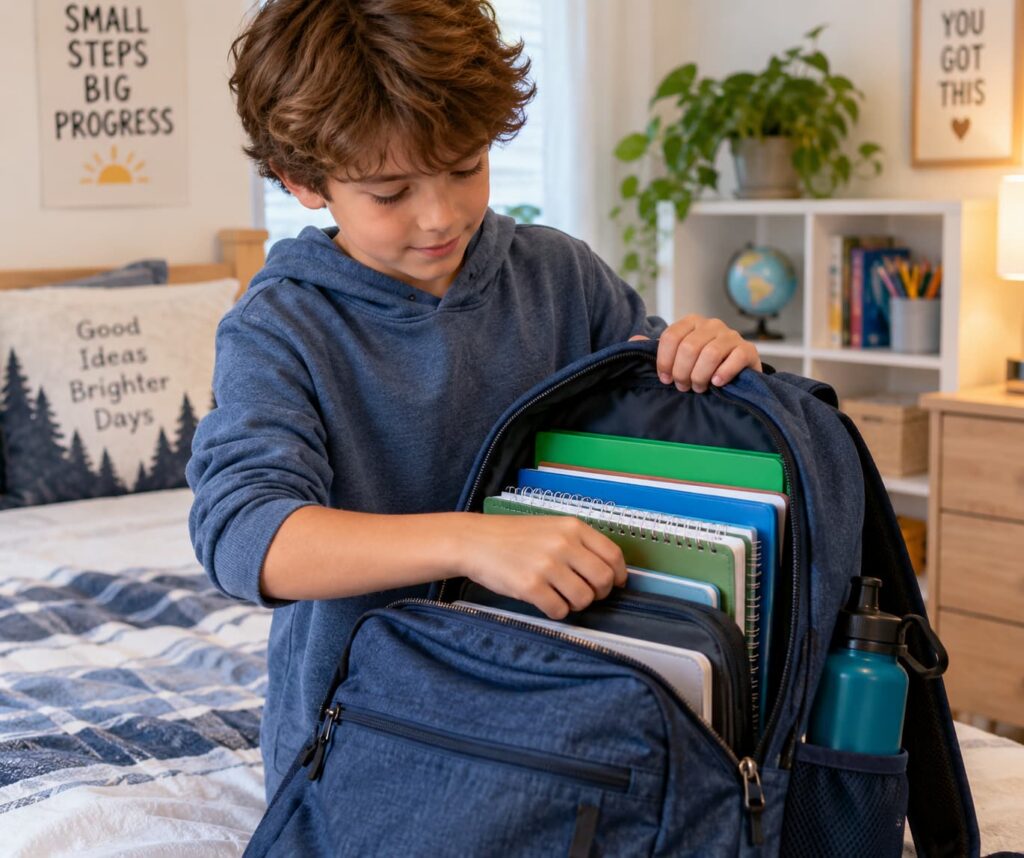
- Packing the school bag every evening.
- Laying out the next day’s clothes before bed.
- Having a set time to start homework.
- Following the same sequence of activities every morning.
Visual schedules with pictures or simple symbols can help children follow these routines much more independently, with less need for constant reminders from parents.
Don’t Overload Them With Too Many Instructions
Working memory is relatively limited in children with ADHD. When you tell them:
“Get dressed, brush your teeth, get your water bottle, check that you have your notebook, and put on your shoes.”
Some of that information simply gets lost.
Instead, it’s better to give only one or two instructions at a time, wait until they’re completed, and then move on to the next step.
It may seem slower, but in practice it saves both time and frustration.
Motivation Begins With Feeling Successful
Children with ADHD often spend years hearing endless comments about how messy, forgetful, or disorganized they are. Constant criticism can lead them to believe that this is simply who they are.
That’s why it’s important to change the way we respond.
Instead of saying:
“You’re disorganized again.”
You can say:
“I noticed that you remembered to pack your backpack by yourself today. That’s a sign that you’re making progress.”
When we reinforce the process rather than only the outcome, the child develops a greater sense of competence and becomes more willing to keep trying.
Involve Your Child in Creating the Organizational System
A system imposed on a child usually lasts only a short time.
When the child gets to choose the colors of the containers, the type of schedule, or the way tasks are marked off, however, they feel that the system belongs to them.
Even if their choices aren’t perfect, that sense of ownership significantly increases the likelihood that they’ll continue using the system over time.
Real Progress Happens in Small Steps
One of the most common mistakes is trying to change every habit at once.
Instead, it’s better to choose just one goal.
For example, during the first week, focus only on packing the backpack before bed.
Once that habit becomes established, add another goal, such as laying out clothes or organizing the study desk.
This allows the child to build on a series of successes that can last over time.
In Conclusion
Organization isn’t a personality trait. It’s a skill. For children with ADHD, that skill sometimes develops more slowly, but it can absolutely be strengthened.
When parents stop viewing these difficulties as a discipline problem and begin seeing them as a developmental challenge, the way they approach them changes too. An adapted environment, consistent routines, breaking tasks into manageable steps, positive reinforcement, and realistic expectations can work together to help a child develop genuine independence.
The goal isn’t perfection, but consistency. Every task a child manages to complete independently, no matter how small it may seem, is another step toward developing skills that can stay with them into adulthood.