
As someone who decided to go back to school to earn a degree at the age of 37, there definitely was guilt involved, guilt that maybe my pursuing an education would be harmful for my kids, because of the time it takes away from them and the extra things I need to juggle. This article is a good reminder, though, that there are benefits to your children when you go back to school- they learn independence.
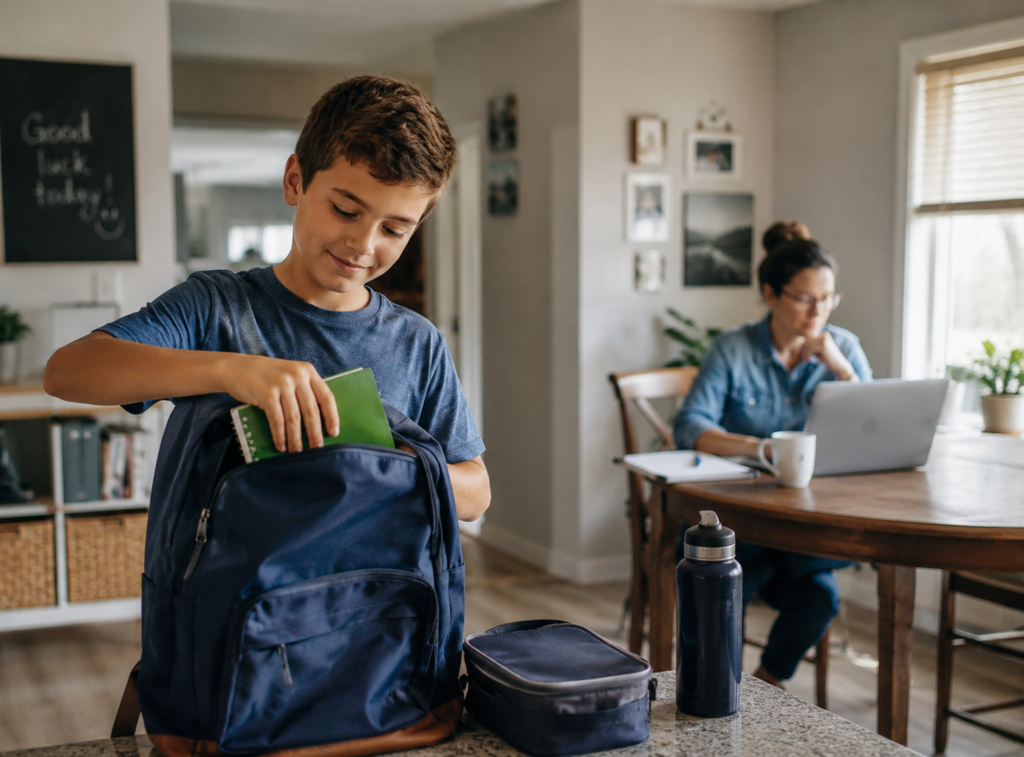
Going after something for yourself—a degree, a certification, a career change—does not have to come at your kids’ expense. In fact, the season when you are most stretched can become the same season your children learn to do more on their own. The trick is to treat their growing independence as part of the plan rather than a casualty of it.
Most parents discover this by necessity. When your evenings fill with coursework or your weekends with shifts, someone else has to start the homework, find the missing shoe, and remember the dentist appointment. Handing those pieces over is not neglect. Done on purpose, it is one of the more useful things you can give a child.
When You Chase a Goal, the Whole House Grows Up a Little
If you are weighing your own next step, you are in large company. Nearly one in five undergraduates is raising children while enrolled, and the typical student parent is around 35, well past the traditional college age. These are people fitting class deadlines around bedtime routines, often as the only adult in the home.
Parents who have written candidly about balancing university with single parenting tend to describe the same turning point: the moment they stopped trying to do everything themselves and started letting the household carry part of the load. The shift feels like surrender at first. It usually turns out to be the thing that makes the whole arrangement work.
Children notice it, too. When a parent visibly works toward something hard, kids absorb a lesson no lecture delivers—that effort, scheduling, and the occasional rough week are simply what growth looks like. Your goal stops being the thing that competes with them for attention and becomes a live demonstration of the persistence you want them to build.
Independence Is a Skill, Not a Risk
It is easy to read a child’s self-reliance as a sign that you are dropping the ball. The research points the other way. A widely cited review in The Journal of Pediatrics links the long decline in children’s independent activity to rising rates of anxiety and depression among young people.
The argument is straightforward. Kids who never get to make decisions, solve small problems, or handle unsupervised time do not end up feeling safer. They end up feeling less capable. Confidence is built by doing things, including the things that occasionally go sideways.
Age-appropriate independence builds exactly the muscles parents hope to see: decision-making, problem-solving, and the self-regulation to stay with something difficult. A nine-year-old who packs her own bag and a fourteen-year-old who manages his own assignments are both practicing skills that compound for the rest of their lives.
None of this means throwing a child into the deep end. Independence is scaffolded: you hand over one responsibility at a time, watch how it lands, and add the next once the first is steady. A kid who masters the morning routine this month is the kid you trust to walk to a friend’s house next month.
That reframing matters when guilt creeps in. The hours you spend on your own goals are not hours stolen from your children’s development. Handled well, they are the conditions under which that development actually happens.
Build Routines That Run Without You
Independence works best when it sits on top of a structure. Kids handle self-direction far better when the framework around them is predictable—they know what comes after school, where their things belong, and what has to happen before screens come on.
Start with the parts of the day that repeat. Morning sequences, after-school check-ins, and homework windows can all become routines a child runs without being chased. Visual checklists work well for younger kids; older ones can keep their own calendar and own the consequences when they forget it.
It also helps to name the new expectations out loud rather than letting them creep in. A child copes far better with, “Starting Monday, you’ll get your own breakfast on school days,” than with a silent shift they have to decode on their own. Clear handoffs feel like trust; vague ones feel like being left to fend for themselves.
Schoolwork is the obvious place to step back, and also the easiest to get wrong. The aim is a child who owns their assignments, not one left to sink. You can stay available without hovering, supporting a child’s schoolwork without pressure so they remain in charge of it while knowing you are still within reach.
Expect the system to wobble. The first week a routine runs without you, something will be forgotten. That is information, not failure—you adjust the checklist and try again. Parents who have learned to stretch limited time and energy tend to be ruthless about which routines are worth the effort and which ones quietly are not.
Give Kids a Safe Way to Reach You
Independence and connection are not opposites. A child who is more on their own—walking home, staying solo for an hour, or riding to practice—needs a reliable way to reach you, and you need one to reach them.
This is where most families land on a phone. Among parents whose child already has one, the most common reason they allow it is simply to stay in contact with their kids, and roughly six in ten children have their own phone by ages 11 or 12. The pull toward a device is less about status than about safety.
For a first device, the harder question is what, not when. A full smartphone hands a child the open internet, social media, and endless games at the exact moment you are trying to build focus and self-control. Choosing a safe first phone built for kids—one made for calls, texts, and location-sharing rather than scrolling—gives you the safety net without the distractions that undo it.
The point is reachability, not surveillance. The phone lets a child tell you they made it home, and lets you tell them you are running late for class. It supports independence instead of monitoring it away.
Choose a Goal That Bends Around Family Life
Your own plan has to fit the household rather than fight it. A program that demands rigid daytime hours collides with school pickups and dinner; one that flexes around your schedule survives contact with real life. That is why so many parents returning to school gravitate toward online programs built for working adults, where you take one course at a time on a schedule you can actually keep.
The same logic applies to whatever the goal happens to be. Parents pursuing an advanced degree while raising kids often look for accelerated or stackable paths that shorten the stretch the whole family has to absorb. Shorter and more flexible almost always beats prestigious but rigid when there are children in the house.
Pick the format first, then the program. The most respected option on paper is the wrong one if it quietly requires you to be in two places at once every weekday afternoon.
Keep the Cost—and the Guilt—in Check
None of this requires money you do not have. Independence is mostly free; it costs intention, not cash. A first phone built for kids tends to run well below a flagship smartphone, and flexible study formats often let you pay course by course instead of all at once.
The harder cost is emotional. Pursuing something for yourself while your kids take on more can feel selfish in the moment, especially on the days the routine collapses and someone cries over a forgotten worksheet. It helps to remember what the arrangement is actually teaching. A child who learns to manage a morning, reach a parent when it matters, and recover from a bad day is being set up to handle far more than a school year—and they are learning it by watching you do the same.