
This post is written by team member, Charlotte Cowan.
As a young and idealistic dreamer, I was absolutely obsessed with the 2001 movie, Moulin Rouge! When it came out, I watched Nicole Kidman and Ewan McGregor’s electric on-screen chemistry over and over again, singing my heart out, knowing every line by memory. Completely oblivious to anything I was supposed to be doing, I escaped into that bohemian world where anything was possible if you only dared to dream.
The words, “Love is a many-splendored thing,” became deeply imprinted on my aspiring, romantic heart.
Little did I know that heart, more accurately, that wonderfully creative, imaginative mind, was a stereotypically ADHD one. And those Bohemian themes from the Baz Luhrmann classic provided me with the ample reason-detre I needed for losing hours and hours of valuable time on the beautiful, yet fictional, illusion of real life.
At the time, I didn’t recognise this escapism, my constant daydreaming, impulsivity, disordered relationship with time, as symptoms of something. Those puzzle pieces didn’t come together until I was eventually diagnosed with ADHD at the age of 30.
One day, during teacher training, time actually stood still for me, while listening to a very animated, engaging and dedicated professor describing how often girls with ADHD slip through the nets of recognition. How they tend to be quiet dreamers gazing out the window in class rather than the noisy disruptors classically, then, associated with ADHD. How they tend to flit from task to task rather than see one thing through to completion. How time seems to escape their grasp… she was describing…ME!
And although I finally had validation, education and more self-knowledge, my sense of time continued living in the magical world of Moulin Rouge, where there was always another tomorrow, another burst of inspiration, another chance to squeeze in one more thing before leaving the house. As a creative, excitable, imaginative young woman, life flew by in a blur of forgotten appointments, impulsive decisions, unfinished projects, and countless breathless apologies of, “Sorry I’m late!”
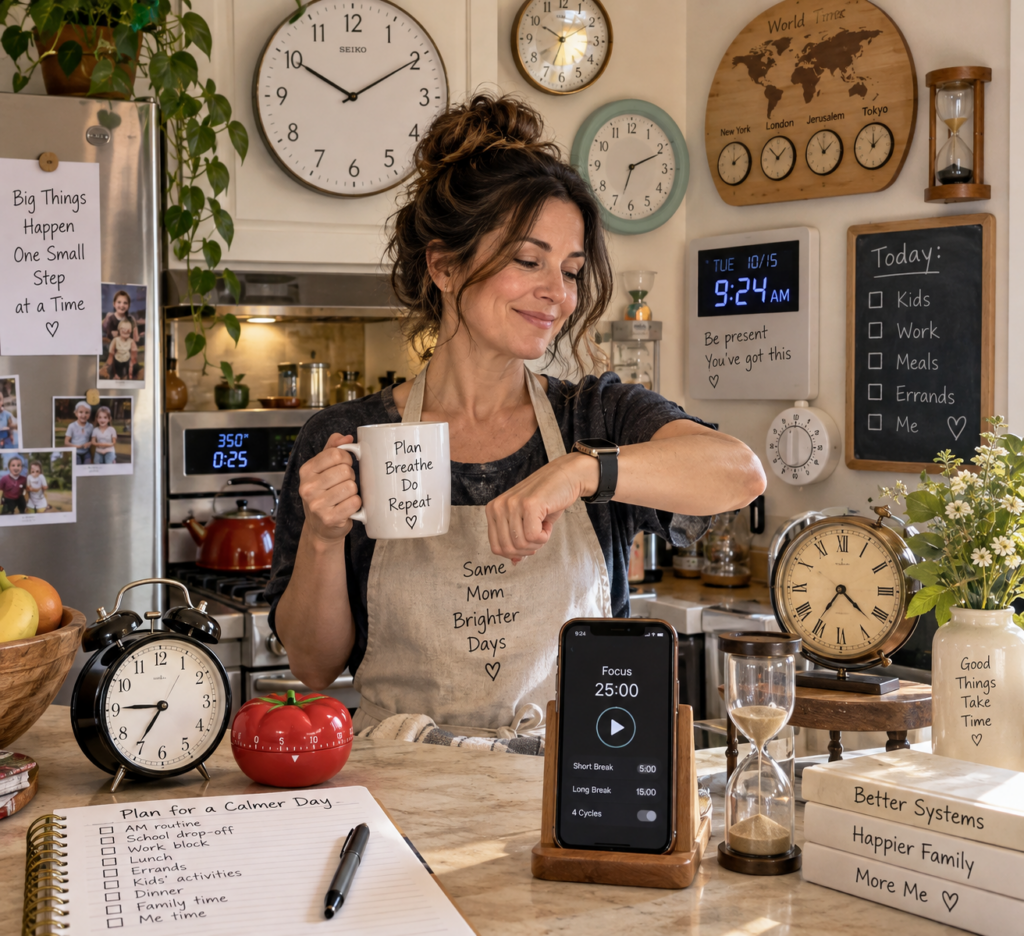
Looking back, I can now see that my greatest struggle wasn’t organisation or motivation. It was time itself. Not clocks or calendars, but my brain’s inability to experience time the way other people seemed to. That invisible struggle has a name: time blindness.
Fast forward to today. I’m a literature graduate, a teacher with over 20 years experience, have encountered numerous children with varying degrees and manifestations of ADHD, and am a mother to five children, some of which have beautiful, unique, neurodivergent brains of their own. As a now-ADHD coach in-training, and a dedicated and constant learner, I’m only just getting started in harnessing time in a way that supports me, my life and my goals, whilst leaving its runaway train element far behind.
What Is ‘Time Blindness’?
What is ‘time blindness’, one may ask? Everyone runs late and misses things in today’s fast-paced world, so how are you any different? It’s a great question and, as a quick description for those here wondering if this relates to them, here are some brief examples of how an ADHD brain relates to the measure of time:
- Thinking 5 minutes is “plenty of time”
- Underestimating or overestimating how long tasks take
- Hyperfocusing on a usually unimportant, yet deeply interesting task until hours somehow are swallowed, never to return…
- Always believing your future self will somehow manage everything you delay completing in the now.
And only now am I beginning to experience what it feels like to work with time instead of constantly chasing after it. Do I still have slip-ups? Absolutely. But I’m no longer a passenger on time’s runaway train.
So what changed? The biggest game changer for me was learning to move time from being an abstract concept into something concrete: something physical I could manipulate, segment and give a certain quality to.
Instead of feeling owned by time, I began owning my time.
Here are the biggest changes that started creating the shifts I needed:
1. Time-Blocking Endless Tasks
As a mum, some jobs are literally never finished.
Laundry. Dishes. Meal preparation. Cleaning.
They don’t have a final end. For years I waited until I “felt like” doing them or until they became absolutely essential to function. Think last pair of underwear/last dish in the cupboard scenarios…
Now, I give them a home in my day.
Rather than saying, “I’ll do the washing later,” I might decide that after school drop off from 9:00-9:20am is laundry time.
The task doesn’t need a deadline.
It needs a place in my day.
That simple shift has dramatically reduced my decision fatigue.
2. Morning and Evening Routines – for Myself
For years I poured all my energy into creating routines for everyone else.
But once I was in stay-at-home mum mode, I had nothing grounding my own day. And my own mind. Now I have various tasks in the morning and evening that are solely in place to regulate me. Once I’m soothed and grounded, I can relate to time more effectively.
So instead of hours of doom-scrolling (which took the place of re-plays of Moulin Rouge and other movies…) I include tasks such as:
- Meditation
- Exercise, sometimes just walking
- Journalling
- Brain-dump writing
- Enjoying a quiet coffee alone
- Limiting technology first thing in the morning and last thing at night
When I look after my brain first, I spend far less of the day feeling rushed, scattered, and reactive.
3. Letting Go of All-or-Nothing Thinking
This one changed everything.
Perfectionism disguised itself as high standards, but really it fuelled procrastination.
If I couldn’t do something perfectly, I’d avoid starting altogether.
Eventually I truly embraced the phrase, ‘Done is better than perfect.’ Not just as a nice quote but as a way of acting. Ironically, once I stopped trying to do everything perfectly, I actually got far more done. The overwhelming feeling of “There’s never enough time!” rarely dominates my thinking anymore.
4. Learning That Saying “Yes” to Others Often Meant Saying ‘No’ to Myself
This was perhaps the hardest lesson. I realised I was constantly saying yes to everyone else while saying no to myself. Need a lift? Of course. Need someone to lend a hand? No problem. Need someone to listen? I’m there.
Meanwhile, my own goals quietly waited, and caught dust, in the background.
Helping others often became a convenient way of avoiding the difficult things I needed to do, like filling in my tax return or emailing customer service about receiving the wrong item.
This behaviour felt productive. And I felt I was staying true to my kind and giving nature. But often, it was avoidance dressed up as kindness.
Learning to say, “I’m sorry, I can’t today,” has been one of the greatest gifts I’ve given myself.
These were my personal game changers. They’ve required brutal honesty, plenty of practice, and a willingness to ask for help. Progress hasn’t been perfect, and it never will be…but the journey has been deeply liberating.
I still love Moulin Rouge. I still lose myself in stories. I still believe in dreams, romance, creativity, and possibility. Learning to manage time didn’t make me any less passionate or imaginative. It simply taught me that dreams need structure if they’re ever going to become reality.
Time isn’t my enemy anymore. It’s no longer the villain stealing my plans. Quietly, imperfectly, and one day at a time, it’s becoming one of my greatest allies.