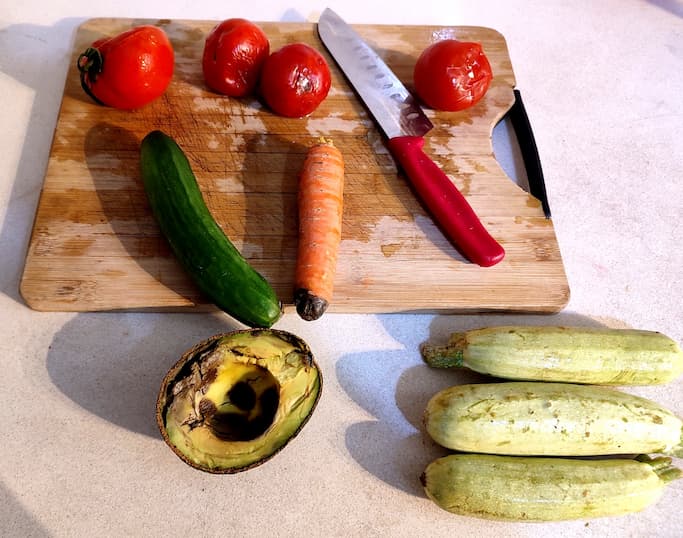
This post might make some people happy and might make some people very angry. It’ll be like the good old days of Penniless Parenting, when I wrote extra frugal but controversial stuff that people who needed to live very frugally were appreciative of, but others got upset about because it bucks conventional wisdom. It’s about what to do when your vegetables are partially spoiled, what to keep and what to throw out, and how to use them. These aren’t just your past-their-prime vegetables that aren’t quite so fresh anymore. These are vegetables that many people would already chuck in the bin.
The reason this post is going to be controversial is because I know it doesn’t follow conventional food safety rules, especially regarding mold, so I’m adding the caveat that you should use these tips at your own risk. My family hasn’t been harmed by my following these tips, though that doesn’t guarantee they’re safe.
During my really poor and extremely frugal days, I used to go to the open-air market, where they would be throwing out produce like this, and I would rescue it from the trash, take it home, and use it following these tips. Today, I just use these tips when things have been sitting in my fridge for too long and end up like this.
You don’t have to be extremely frugal or poverty-stricken to follow these tips. Fortunately, I am no longer in a place where I need to be extremely frugal, but I still live like this because I prefer to minimize food waste as much as I can, and I have a tendency to forget food in the fridge until it starts to spoil because of my ADHD.
Additionally, if you want to avoid going to the grocery store as frequently, you may be buying larger amounts of produce, and some may start to go wilty or worse between trips. Or you might need to cook dinner and realize that your fridge only has vegetables that look like this, and if you toss them, you’ll need to go to the store before preparing food, which you might prefer to avoid.
Whatever your reason for trying to use up your veggies instead of tossing them, these are just my rules of thumb for different vegetables and my personal comfort level, not any USDA-tested or approved food safety rules or anything similar. You might not feel comfortable using them, or you might use things that I toss. To that I say, to each their own. This post is just to open your eyes to what parts I save from partially spoiled veggies, in case you’re looking to do the same.
I’ll start off with my general rules, and then go to specifics for how I deal with different vegetables.
Absolute Bottom Line Rules
- Fuzzy mold is a no no.
- Powdery mold is out.
- Black gets removed.
- Slimy parts get removed.
- Mushy parts get removed (for most veggies- I’ll write exceptions).
- Wilty is not mushy. Wilted or wrinkly vegetables can be eaten raw or cooked with nothing removed.
- Avoid wet, gross and yucky parts.
- Cut out a margin around any moldy or slimy bits. I usually just do a few millimeters but acknowledge that most reputable places will tell you to cut off far more.
- Discoloration that isn’t black depends on the veggie.
- When in doubt, peel. If the inside is good, keep it.
- Taste test before using if you can. Sometimes things can look fine peeled but become bitter. (I’m looking at you, zucchini, carrots, kohlrabi, and radishes.) You can taste a tiny sliver from a batch; you don’t need to taste every single vegetable.
- Cooking kills germs. If you can cook these vegetables, it’s best. It also kills spores that cause spoilage, so if you cook them, you can extend the life of these vegetables even further, giving them a new lease on life, extending them for another week sometimes.
- Pickling in vinegar also extends the life of these partially spoiled veggies. Do not salt pickle them- you will just make the whole thing spoil.
Ok, and now for specific veggies.
Carrots
I find that carrots usually go black either in spots or along the whole thing. Sometimes they can also get slimy, but rarely.
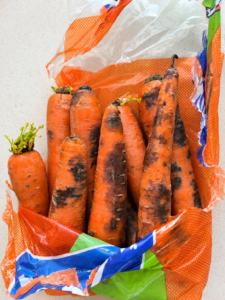
Peel the whole thing until you only see orange and don’t feel anything slimy.
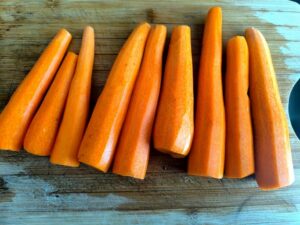
Use cooked.
Zucchini or Summer Squash
Zucchini/summer squash can get mushy, slimy, or moldy. Sometimes it gets black or brown spots.
Cut away any mushy, slimy, or moldy parts.
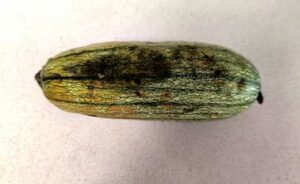
Peel anything brown or black until you completely expose the white flesh beneath.
Taste the zucchini.
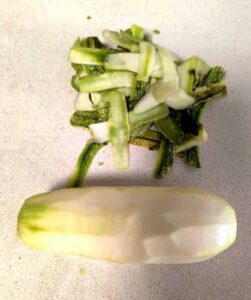
Use cooked.
Tomatoes
Because tomatoes are wet, I am more concerned about spoiled juices spreading throughout the vegetable, so I cut off more from tomatoes if the spoilage reaches down to the inner part of it.
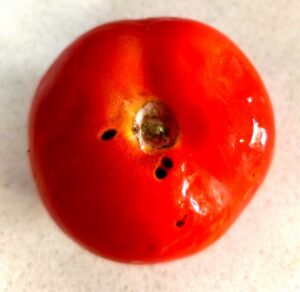
If tomatoes just have tiny black spots like in this picture here, I cut them off with a paring knife, leaving a few millimeters as a margin.
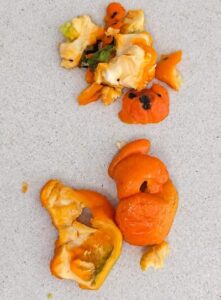
If, however, they look closer to the tomatoes in the top picture of this post, wet looking, or with fuzzy mold, I’ll cut off much more. I’ll cut off any wet and mushy part of the tomato (again, not the wilted/wrinkly part, just the wet and mushy/moldy part). I leave about a centimeter or more of a margin, often cutting off an entire third or half of a tomato if it looks like that, and sometimes will toss the whole thing. Tomatoes are one of the veggies that will get tossed the most in my house because I won’t rescue them in many cases.
Peppers
Cut off any slimy parts of peppers. Cut off any moldy parts.
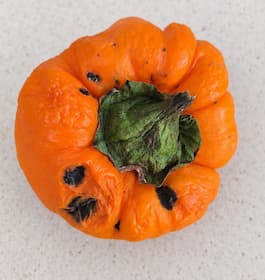
Cut off any black spots.
Check the inside of the pepper to make sure it isn’t slimy inside or discolored or moldy inside, because sometimes with just a bit of black on the outside, the inside is yucky.
I ate the pepper in this picture raw since it only had black on it and no slime or fuzzy mold and the pepper isn’t juicy like a tomato. But feel free to cook it first.
Onion
Peel off any soft, slimy, or brown layer. Wash off any black soot. Use them raw or cooked.
Cabbage
Peel any dried out and unappealing outer layers. Cut off any brown parts. Use raw or cooked.
Potatoes
Cut off any moldy, brown, or black spots. Remove any soft spots.
Butternut squash
Cut off any moldy, brown, or mushy spots.
Sweet potatoes
Cut off any moldy, brown, or mushy spots.
Fennel
Cut off any brown slimy bits. Cut off any dried out thin edges. Peel off outer layers of the fennel if they’re gross to access the inner better section.
Beets
Cut off any black spots. When the outside is black it often is black on the inside, so cut out those yucky parts as well. If anything is moldy, just peel that off.
Radishes and Turnips
Cut off any moldy bits, black bits, or dark brown parts. Remove anything slimy. Peel the radish if it looks gross. (I assume you’re peeling the turnip anyhow.) If it is stringy on the inside, toss; it’s not spoiled but will be very unappetizing to eat. Taste to make sure it isn’t bitter as these get bitter as they age.
Avocado
Carefully peel away the outside and leave any moldy bits in the peel- this is easier when the peel is hard. Brown slimy bits cut out, darker brown stringy bits I personally keep in, as long as it tastes ok. In the avocado in the top picture, I’d scrape out the black next to where the pit was, remove the moldy upper left quarter, remove the edge of the upper right quarter, and use the rest.
Scallions
Remove any dried out or slimy bits. Peel off an outside layer of the white part if needed and use what is inside.
Lettuce
Remove dried out, brown, or slimy bits. Wilted bits can be used. If you don’t want to use them as is, feel free to toss them into any cooked dish as you would spinach or other greens, such as sauces, soups, risotto, or stir fries.
Greens- Parsley/cilantro/mint/spinach/dill/basil
Remove any dark brown or black or dried out bits. I personally will use yellowing or light brown bits of cilantro and parsley. Remove anything slimy.
What vegetables did I miss? How many of my rules of thumb do you use for using up really old veggies versus how many do you think are too strict or too lax? What are the rules you follow? Just how angry did my post make you? Haha!